Security systems and move-in day

Tomorrow is move-in day, and what better time to talk about security systems, since there will actually be possessions in the house for the first time.

Security is kind of a tough thing to blog about since the more I publish about my setup, the easier it would be for miscreants to subvert it. I’m sure everyone reading this blog on a regular basis is an honest member of society, but you never know who might come in through Google one day. So… for that reason, I must say very little. What I will say is this though: I’m going to lay out a few details in this post about how we secure the house and then I’ll do a separate, more comprehensive post on all the great home automation we’ve built in.

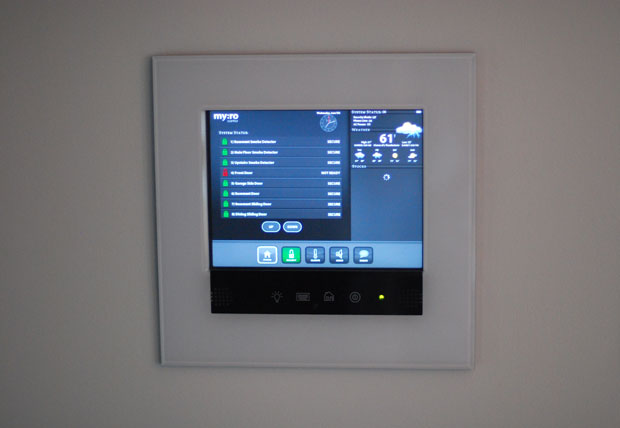
To start off with, we have contact sensors on every single opening in the house. Doors, windows, sliders, Nanas, garage door… you name it. When any perimeter orifice is opened, the central alarm/automation system knows about it. This is not only useful for security but also for doing cool things like turning on lights when doors are opened.

The second layer of protection is glass breakage sensors. We have these all over the house. They work by detecting the audio frequency emitted when glass is broken. If any window in the house breaks, the alarm/automation system knows about it.

The third layer of protection is motion sensors. As the name suggests, these trigger when they detect movement in the house. Some people choose to keep these on only when the house is empty and some people have certain zones on all the time. These are also useful for doing things like automatically turning on the stair lights when you’re about to walk up or down stairs.

We also have a siren on each floor and one on the roof for maximum ear piercing delight. When the alarm triggers, a monitoring service is alerted as well as a few cell phones including mine.

There’s a bit more to it than this even, but we’ll just leave it at that for now. I will say this: if you’re building a house, do not skimp on wiring, whether it’s alarm wiring or data. It’s very tempting to ask yourself “do I really need a sensor here?”, but spend the extra few bucks and run every single wire you could possibly need. You won’t regret it. Most of these sensors are less than $20 apiece (for top of the line, great ones even!) so all you’re really paying for is your wiring guy’s labor. Well worth it.

Do not worry about overwiring. Do worry about underwiring.

I’m really looking forward to move-in day tomorrow. There are several more big posts coming including the hardwoods, the landscaping, the kitchen, and the bathrooms.

UPDATE: Nina in the comments reminded me about cameras. I totally forgot to mention those. We have several infrared, high resolution, night-vision cameras which monitor almost every angle of the house 24 hours a day. The footage is available live via a streaming server as well as recorded via a dedicated DVR. Everything is also on battery backup in case of a power failure.

The concrete floor saga

This is a post several months in the making. I’m only able to write about it now because it’s officially resolved and I’m satisfied with who I should name, who I shouldn’t name, and what the costs have been to me as a homeowner. As I’ve mentioned before on this blog, I’m very careful about naming subcontractors on this site because Google search results have the ability to make or break someone’s business, depending on what is written about them.

I have three categories I put subcontractors in:

  • Did a great job, would recommend. So far, almost everyone has fit into this category. If you do a great job, charge me a reasonable fee, and are someone I’d recommend to others, I write about you here and link to your site if you have one. Hopefully this leads to more business for you. My landscape person, Alex at Alexandria’s Creations, recently told me she’s gotten a several new clients from this site, and I haven’t even written the final glowing post on the landscaping yet.
  • Things didn’t go well for one reason or another, but the person was honest and tried to make it right. In this situation, I write about the process but keep the contractor’s name out of it. Only a few subcontractors so far have fit into this category. If I wrote about the entire process and named the company, it would have the effect of casting the company/person in a negative light, and I do not wish to do this. If you are honest and tried to make things right, you shouldn’t be subject to a full writeup about everything you did wrong.
  • Things were a disaster and I want to publicly warn readers to stay away. Nobody has fit into this category yet, but there have been a couple of situations where the final resolution saved someone from this group and put them in the previous group.

I don’t tell any workers about this system and I’ve never used it as an overt incentive/threat in order to get anything done. Not a single time. If you’re working on my house and you happen to find out about this site, you can draw your own conclusions as to how you may show up on it, but in most cases, people don’t even know about it until they get referrals weeks or months later.

Ok, now that that’s out of the way, on to the concrete floors…

In planning the “grand entrance” for the house, we had a lot of choices: bamboo to match the floors, concrete to tie in with the steel, slate to keep things affordable, and linoleum to completely ruin the entire project if we so desired.

We liked the idea of concrete the best, but because of the existing subfloor elevations and some weight issues, we couldn’t do a full, thick poured concrete floor. We were turned onto a product, however, that’s been around for quite awhile now called a “concrete terrazzo overlay” or “decorative concrete overlay” floor. It’s essentially a poured floor made of concrete and aggregate but is only an inch and a half or so thick. It was about the most expensive option available at about $9,500 for 400 square feet. This cost included in-floor heat, but it was still probably twice the cost of something like slate. Nevertheless, it was a very public part of the house, so we went for it.

Around the beginning of February, work started on pouring the floor. It was only supposed to take a week or so, including the 7-step polishing process, but it ended up taking about 2.5 weeks. A loud, dusty 2.5 weeks. When the grinding and polishing was almost done, I noticed several cracks across the floor, some of them pretty major. Concrete workers always warn you that you should expect a few cracks when you choose concrete as a floor option, but given the fact that the thing wasn’t even fully installed yet, I freaked out a little. The company tried to fix one of the cracks and it seemed to make things worse.

I wasn’t feeling very good about things at this point, but we couldn’t hold up the rest of the construction and needed to cover up the floor with protection for the next few months as other work continued. Given the fact that the company needed to come back towards the end of the project anyway to do the final polishing, the decision was made to just deal with it then (incidentally, I don’t recommend doing this… deal with everything at the time, if you can).

Well, a few months went by, we completed most of the rest of the house, and it was time to uncover the floor and bring it up to snuff. To our surprise and dismay, there were now over 20 cracks in the floor. Mind you, none of these cracks were concerning from a structural standpoint as they were all hairline in size, but to have your brand new concrete floor dominated by very visible and ugly cracks is disappointing to say the least. We called the owner of the company in to have a look and were a bit worried he’d say this was “completely normal”, but even he agreed this was out of ordinary and not something he anticipated.

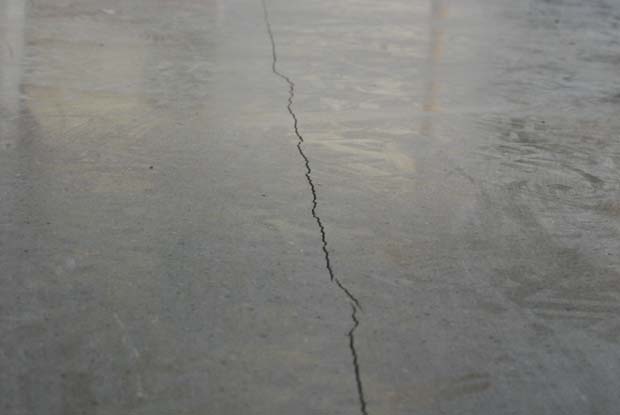
One of the approximately 20 cracks. This was the worst one.

We had two options: try to fill the cracks with color-matched grout or grind the whole thing down and do something else on top of it (like more of this product or maybe ultra-thin slate tile). The decision was made to try the grout option first as it had the least project/cost impact. Unfortunately the grout ended up making the cracks even more conspicuous.

At this point, we called the company back and expressed our disappointment with the grout fix. The company did not immediately return our e-mails so we prepared ourselves for a situation where they would walk away from the project (I had paid them about $8000 so far and still owed about $1500).

Build recommended we call a company they’d used before called Cirvell that uses a product called Milestone, which is essentially hybridized portland cement. The product has a “hand-troweled” look and isn’t as “shiny and pristine” looking as the concrete terrazzo overlay, but at only a sixteenth of an inch in thickness, it could be troweled on top of the existing floor with no grinding whatsoever.

We informed the original concrete floor company that we were proceeding with the Milestone option and that we felt a refund of half of the fees paid so far was a fair arrangement for both parties. This would leave me paying $4000 for a heated concrete subfloor, plus $2500 for the Milestone coat. To his credit, the owner of the original concrete company sent us a check for $4000 and we’ve now parted ways, sadly but amicably.

Although I was obviously not happy with the concrete terrazzo floor, the way the company owner handled the refund showed me he was an honest guy and someone who cared about the quality of the product and service he was providing. He could have easily just walked away and stuck me with the bill, but making things as close to “right” as possible was important to him, and that is why I’m not interested in steering readers away from his product. He’s no doubt done hundreds of successful floors… just not mine, and for we know, there was something about the construction, or temperature, or humidity in this job which conspired to not let the product cure correctly.

Thankfully, the folks at Cirvell were able to give us an end result which we’re quite happy with. They completed their work in only a few days, for a reasonable cost, and have graciously offered to come in and fine-tune the tint of the floor after we move in, if we desire. I do not hesitate to recommend them if you’re looking at Milestone as an option in your own home.

Here’s what the finished product looks like now. Plus one for Milestone.

… and with that, the concrete saga is thankfully resolved. For more photos of the floor, please visit the photo gallery.

Costs accrued during this stage:

Concrete terrazzo floor$4,159.88
Milestone overlay (Cirvell)$2,500.00

The new awning and front stairs are complete

We’re in hopefully the last week of work right now, as various punchlist items get taken care of and we get ready to move in. One item I discussed several weeks ago in “Offing the Awning” was the poor appearance of the front canopy. I’m happy to say that this has now been successfully resolved and we have a beautiful new canopy in front which ties in much more tightly to the overall design of the house:

The fir from the canopy, door, and stairs now tie together beautifully.

The puck lighting underneath the canopy provides just the right amount of light to illuminate the wood.

The fir stairs provide a warm entrance and the aluminum underneath offers a minimalist support structure.

Overall, I’m extremely happy with the finished product. This is one of a handful of items we pushed back on very hard from a design standpoint, and although it felt stressful and unsatisfying at the time, I’m really glad we insisted on this refined approach. It cost me a few thousand dollars in the end, but since we’re still using the steel frame of the original canopy inside of the aluminum/fir casing, it’s still providing some value. UPDATE: Kevin from Build pointed out to me that although the finished cost of the canopy is more than originally spec’d, not a penny of the cost was actually wasted due to the fact that the steel frame is simply acting as the skeleton now. Fair point.

Not to be overlooked, the fir stairs are also the result of pushing back against a proposed solution (steel) that we never got comfortable with. The lesson for this phase of the project is: if you aren’t comfortable with a certain material, insist that it be eliminated as an option early on. Occasionally you will be pleasantly surprised by such things, but more often, you know your tastes better than anyone else does.

Costs accrued during this stage:

Front canopy fabrication (Twisted Metalworks)$1,000.00
Galvanize front canopy (Scott Galvanizing)$416.10
Aluminum for redone canopy (Alaskan Copper & Brass)$687.00
Aluminum anodizing for redone canopy (Hytek Finishes)$300.00
Delivery of anodized aluminum for redone canopy (Pacific Delivery)$130.81
Delivery charges (Pacific Delivery Service)$352.18
Miscellaneous materials (Compton Lumber)$1,198.59
Aluminum fabrication for redone canopy (Special Projects Division)$832.20

Ok, now we’re really almost done

In my last post from six weeks ago, I wrote that we were three weeks away from completion according to the schedule, but that it felt more like six weeks out to me. Well, it’s six weeks now, and we’re mere days away from final inspection and an occupancy permit. As of now, we’re aiming for next week.

A lot has gone on in the final two months of construction that has served to push our date back, including:

  • An extensively cracked concrete floor
  • Various parts — mostly electronic — which are not stocked locally and have taken weeks to arrive
  • Redoing the awning
  • Redoing some tile
  • Settling on a lighting scheme
  • Dealing with the technological circus that is our exterior motorized blinds

… and several other things.

I haven’t posted about all of this stuff individually yet, because I’m waiting for resolution first. Since I’m naming sub-contractors here (generally endorsing their good work), I don’t want to publish a negative post when something goes wrong only to have the sub-contractor go out of their way to make everything right. I try to judge everyone on this job not just by their ability to avoid problems but mostly by the final outcome of their work. For things like our bamboo floor, our concrete hallway, and the motorized blinds, the “final outcome” has been very much in limbo for months now as contractors finish up their work. When it’s all done next week, I will have full posts on each item.

We’re still very much on budget, and although we are about two months past the originally planned completion date, I would argue that date was too aggressive to begin with. Nice houses take time, and 9 months just isn’t long enough. If we get done in the next two weeks, it will be 11 months from when deconstruction began, and I’m perfectly satisfied with that duration.

Coming down the home stretch

According to the schedule, we’re only about three weeks away from occupancy now. From looking at the house, it feels more like six weeks, but I’m told things come together extremely rapidly at the end. So many of the surfaces are still covered in protection and there’s so much dust and debris around that it just looks a lot less finished than it actually is. On the bright side, coming to the house every day now is a complete joy as a new element is finished and uncovered almost every day.

If we really end up being done in three weeks, the project will have come in only about five or six weeks late and only about $8000 over budget. I’ll explain this in a later post, but both the time and the budget are a bit misleading though because we added approximately 1300 square feet in the form of a fully finished basement and some other things to the project and still came in close to the original monetary and time budgets.

Things are definitely getting a little hectic as Build and the many different subcontractors involved at this point scramble to put all of the remaining pieces in place. There are a ton of things to coordinate and if I was acting as my own G.C., this is where things would really start to fall apart, if they hadn’t already.

I have a bunch of miscellaneous costs to recognize in this post that have occurred over the last couple of months, so if you have costs turned on, you should see them below.

Costs accrued during this stage:

Millwork supplies (Compton Lumber)$2,062.64
Carpentry labor (Rivera 26 Remodeling)$1,256.51
Carpentry labor (Rivera 26 Remodeling)$1,809.30
Carpentry materials (Compton Lumber)$801.62
Carpentry labor (Rivera 26 Remodeling)$2,890.80
Installs, carpentry, and general conditions (Build LLC)$11,675.00
Honeybucket rental$117.19
Installs, carpentry, and general conditions (Build LLC)$11,295.00
Debris removal (Take-It-Away Hauling)$598.45
Fence rental additional month (National Construction Rentals)$26.67
Honeybucket rental$125.71
Miscellaneous materials (Tacoma Screw)$90.32
Miscellaneous site work (Economy Concrete Cutting)$328.50
Miscellaneous expenses$387.21
Miscellaneous expenses$1,826.51
Gas line install (Puget Sound Energy)$3,651.00
Seattle City Light (power connect fee)$789.00

Offing the Awning

Every so often, a design element just doesn’t end up looking good. Such is the case for the galvanized steel awning that went up above the front door. There are a few things wrong with it, in my opinion, but of course, this is all subjective:

  • The galvanized steel just doesn’t go with the rest of the house and is too industrial looking.
  • The scale does not look right. It’s neither as thick as the elements around it, nor as thin as some of the aluminum details near it. It also seems like it should span all the way across the box.
  • It doesn’t provide a mechanism to cleanly conceal lighting which should inconspicuously light the front door area.

Sometimes when less-than-ideal elements go up, you can make a few tweaks here and there to salvage the situation, but I think this was just a clear (and rare) case of a design miss. Build is working on some ways to keep the steel structure up to provide stiffness and wrap it with a different material, like aluminum or fir, whilst providing a means to conceal puck lighting inside.

My lesson from this is to stand strong against materials you don’t particularly care for. I’ve never liked galvanized steel and underestimated the effect it would have on the front entryway. I’m sure things will work out fine but this is a misstep I would have rather avoided.

It’s Almost Planting Time

As the house nears completion (hopefully only about four weeks away!), we’ve spent the last month researching landscaping options. I’ve heard that most new construction projects end up devouring the homeowner’s entire budget and landscaping is usually the first item to get axed, so I’ve been anticipating that the same would happen with this project. Thankfully, we’re currently still less than $10,000 over our original budget so we can follow through with landscaping.

In talking to a few landscape design firms, it quickly became clear to me that “landscaping” can be as cheap or expensive as you want it to be. For $500, you can put a lawn in, and for $250,000, you can create your own Buchart Gardens. Solo design/landscapers may charge as little as $25 a hour while high end firms are closer to $100.

My problem with spending a lot on landscaping before we even move into the house is that I’m really not sure what sort of scheme will work best yet. There are a few things we know we want like black bamboo and an understated Japanese motif, but beyond that, it’s a crapshoot. For that reason, we’ve hired a woman named Alex Tomy (of Alexandria’s Creations) to collaborate with Build on a design that will get us off to a good start and let us make any modifications or enhancements later. Alex has been taking care of two of our neighbors’ houses for over 10 years so she knows the micro-climate better than anyone. While Build handled the hardscape design, Alex is handling the flora.

We decided to concentrate 80% of our effort on the front yard and 20% on the south side yard for now, since those are the areas in most need of design. The backyard (pictured in the header of this blog) is already beautiful, and although it will get a trim and a bit of a refresh, it can wait.

We also decided to go with a ryegrass/fescue lawn in front, despite some earlier flirtations with ground cover. Thanks to Dave’s encouragement, I think we can easily handle the small amount of maintenance that this will require… and if not, there’s always neighborhood kids to do the mowing. We will, however, be using ground cover in the backyard when we get around to it.

Finally, we also decided to line the house and many paths leading to and around it with black mexican beach pebbles. See this concrete path for the inspiration behind the idea. I’ve always loved this look, and for about $1300, we got 6000 pounds of them… enough line the entire house and probably also create a fire pit with.

I don’t have the final bills for landscaping related stuff yet, but I estimate the actual planting part of it (i.e. minus the hardscapes, decking, etc.) will come around $7,000.

Here’s a detailed breakdown of what’s going in and a PDF of Alex’s handcrafted plans:

Shrubs

  • Hydrangea Macrophylla (Red Mopheads)
  • Hydrangea Quercifolia (Alice)
  • Nandina Domestica (Moon Bay)
  • Nandina Domestica (Moyer’s Red)
  • Osmanthus Burkwoodii
  • Osmanthus Delavayi
  • Pittosporum Tobira (Mock Orange)
  • Pittosporum Tobira Variegata
  • Rhaphiolepis Umbellata (Gulf Green)
  • Viburnum Carlesii (Compactum)
  • Cupressocyparis Leylandii (Leyland Cypress)
  • Lavandula Stoechas Otto Quast (Spanish Lavender)
  • Lavandula Intermedia Grosso (Fat Bud French Hybrid Lavender)

Grasses

  • Carex Buchananii (Viridis)
  • Carex Morrowii (Ice Dance)
  • Carex Pendula (Drooping Sedge)
  • Festuca Glauca (Elijah Blue)
  • Liriope Muscari (Big Blue)
  • Liriope Spicata (Silver Dragon)
  • Ophiopogon Planiscapus Nigrescens (Mondo Grass)
  • Pennisetum Alopecuroides Moudry (Fountain Grass)
  • Phormium Tenax Rubrum (Red New Zealand Flax)
  • Phyllostachys Nigra (Black Bamboo)
  • Stipa Tenuissima (Mexican Feather Grass)
  • Yucca Filamentosa (Adam’s Needle)

Perennials

  • Helleborus Hybrida (Ivory Prince)
  • Helleborus Orientalis (Blue Metallic Lady)
  • Hosta Hybrid (Krossa Regal)
  • Hosta Sieboldii (Elegans)
  • Lilium Oriental Lily

Vines

  • Clematis Armandii (Snowdrift)

Ground Covers

  • Veronica Repens (Georgia Blue)
  • Perennial ryegrass and fescue mix for front lawn

Fallen giant

This Sunday was a very sad day for me. During a weekend visit to the property, we became aware that the beautiful, mature, giant Douglas fir tree standing majestically on the hillside next to us had snapped in half during a brief period of wind gusts on Saturday. For probably about 75 years, this beautiful tree has hosted bald eagles, osprey, and thousands of other birds scoping for prey, cleaning their feathers, or just enjoying a nice view of the Sound. I’ve seen as many as three bald eagles on this tree at once and it was one of the first things that attracted me to the property.

This guy got a few minutes of alone time before his buddies showed up.

This is what the tree looked like before this weekend.

The top portion of the tree had been dying for quite some time and I never expected any regrowth, but neither did I expect the 18-inch diameter upper trunk to snap completely in half during what I would consider fairly moderate winds. The right gust must have just hit the right angle for the right duration and the old guy cried uncle.

This is what the tree looks like today.

A close-up of the carnage.

We’re only four or five weeks away from finally moving in, so it’s incredibly sad to see our favorite element of the landscape decimated before we could really enjoy it, but on the bright side, the tree itself is still up, and what remains is alive and presumably well. It’s still high enough to where the eagles may come back (fingers crossed) but it just isn’t the same without those thick bare limbs providing the equivalent of park benches to our high flying neighbors.

First-world problems, yes, I know… but it’s still incredibly sad. I would have rather seen every piece of vegetation on my property go before that tree.

Landscaping and lawns

There will be another post on landscaping coming shortly, but does anyone have any experience using evergreen “ground cover” as a lawn replacement? We were thinking about just sodding some lawn in initially, but this weekend, we saw some interesting stuff called Stepables which is essentially a collection of evergreen plants you can use in lieu of grass. The stuff apparently only grows 1 or 2 inches tall, never needs mowing, and can be trampled on almost as vigorously as a traditional lawn.

My feeling about lawns is that they are only as nice as the time you’re willing to put into them, and I can’t say I’m willing to put a ton of time in. Evergreen ground cover seems like a really attractive option, although I can’t say I know anyone personally who’s tried it yet. It doesn’t seem to look quite as good as a nicely mowed lawn, but I’d settle for decent looking if it meant zero maintenance… especially if I could walk on it to release an awesome minty fresh scent.

This stuff is called “Blue Star Creeper”. Sounds smokable.

Interior metalwork is complete

Although there are still exterior awnings and deck railings to fabricate, all of the interior metalwork is now complete. Thanks to the precise skills of Pacific Northwest metal master Olda Zinke, I now have interior steel railings all around the house that look like this:

The railing above is from the catwalk, and there are also rails lining two flights of stairs. Photos of those are available in the gallery. It’s a bit unfair to Olda to show these photos at this stage because the railings are still dusty and the stair treads are only temporary (homemade thick bamboo treads will be going in shortly) but I’ll post plenty more shots when everything is all cleaned up and fully fabricated.

If you look through the shots in the gallery, you’ll notice that the stairs are made with one hot-rolled steel stringer on each side attached to the cold-rolled steel railings. This was a bit of a surprise to me as I was expecting a single steel beam down the middle supported the treads from the center. The communication between Build and me could have been a lot better here, but in the end, I think the two stringer system may be a better overall look, especially considering one is recessed into the wall, providing a nice viewport through the treads to the panaromic view behind them.

Costs accrued during this stage:

Interior metalwork (Olda Zinke)$21,765.86
Metalwork delivery charge (Pacific Delivery Service)$316.91